 0969-435-240
 info@ieltslab.edu.vn

 Liên hệ ngay
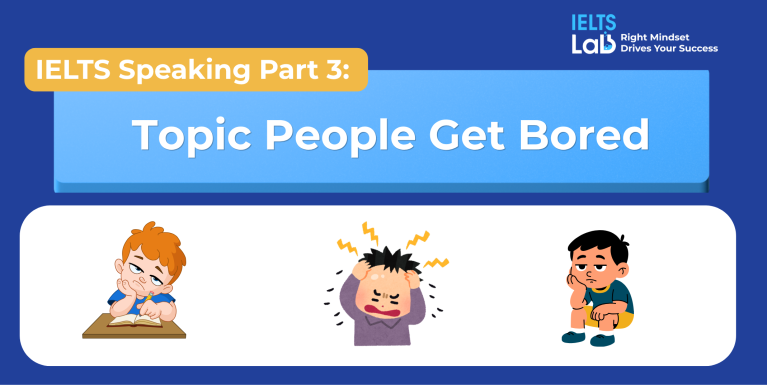
People Get Bored (Sự nhàm chán) là một chủ đề trong IELTS Speaking Part 3, với các câu hỏi xoay quanh nguyên nhân gây nhàm chán, sở thích giải trí, sự khác biệt trong quan điểm về những điều thú vị và tầm quan trọng của việc thử những trải nghiệm mới.
Cùng IELTS Lab tham khảo 7 bài mẫu IELTS Speaking Part 3 chủ đề People Get Bored và những từ vựng hữu ích giúp bạn trả lời tự nhiên, mạch lạc hơn nhé!
1. Danh sách câu hỏi IELTS Speaking Part 3 – People Get Bored
|
2. Bài mẫu IELTS Speaking Part 3 – Topic People Get Bored
Question 1: Why do some people get bored easily?
Sample Answer (Band 8.0+ tham khảo):
| Bài mẫu |
|---|
| Well, I think some people get bored easily because they are used to constant stimulation. With short videos, games, notifications, and social media always available, ordinary activities can start to feel slow or dull. For example, a student who watches TikTok for hours may feel restless when reading a long article or sitting through a quiet lesson. Another reason is that some people do not know how to entertain themselves without external input. If they always need something exciting to happen, they may struggle to enjoy simple things like walking, cooking, or talking with family. That probably explains why boredom today often comes from a short attention span rather than a lack of things to do. |
Từ vựng nổi bật:
| Từ vựng | Ý nghĩa |
|---|---|
| get bored easily | Dễ cảm thấy nhàm chán |
| constant stimulation | Sự kích thích liên tục |
| short videos | Video ngắn |
| notifications | Thông báo |
| slow or dull | Chậm chạp hoặc tẻ nhạt |
| feel restless | Cảm thấy bồn chồn |
| entertain oneself | Tự tìm cách giải trí |
| external input | Tác động, kích thích từ bên ngoài |
| attention span | Khả năng duy trì sự tập trung |
Question 2: What kinds of places do young people enjoy visiting?
Sample Answer (Band 8.0+ tham khảo):
| Bài mẫu |
|---|
| In my opinion, young people usually enjoy places that are fun, social, and easy to share online. Cafés, shopping malls, cinemas, food streets, and music festivals are popular because they allow young people to hang out, take photos, and catch up with friends. In Vietnam, for example, many students like beautifully decorated cafés because the atmosphere feels trendy, relaxed, and photo-friendly. At the same time, some young people enjoy places that offer new experiences. They may go camping, hiking, or joining craft workshops because they want to do something different from their normal routine. Overall, young people tend to look for places that are either socially exciting or personally refreshing. |
Từ vựng nổi bật:
| Từ vựng | Ý nghĩa |
|---|---|
| fun and social | Vui vẻ và có tính giao lưu |
| shopping malls | Trung tâm thương mại |
| music festivals | Lễ hội âm nhạc |
| hang out | Đi chơi, tụ tập |
| catch up with friends | Gặp gỡ và trò chuyện cùng bạn bè |
| beautifully decorated cafés | Quán cà phê được trang trí đẹp |
| photo-friendly | Phù hợp để chụp ảnh |
| craft workshops | Workshop thủ công |
| normal routine | Thói quen thường ngày |
| personally refreshing | Mang lại cảm giác mới mẻ cho bản thân |
Question 3: Do people have different ideas of what is interesting?
Sample Answer (Band 8.0+ tham khảo):
| Bài mẫu |
|---|
| Absolutely, people can have very different ideas of what is interesting because they have different personalities and lifestyles. Some people find museums, historical sites, or books fascinating because they enjoy learning and thinking deeply. Others may find those things boring and prefer concerts, sports events, gaming centres, or amusement parks instead. Age can also make a big difference. A teenager may enjoy a noisy entertainment complex, while an older person may find a quiet garden or a traditional market more appealing. I suppose interest is highly personal, and it depends a lot on people’s energy levels, background, and life experience. |
Từ vựng nổi bật:
| Từ vựng | Ý nghĩa |
|---|---|
| personalities and lifestyles | Tính cách và lối sống |
| historical sites | Di tích lịch sử |
| fascinating | Hấp dẫn, lôi cuốn |
| think deeply | Suy nghĩ sâu sắc |
| sports events | Sự kiện thể thao |
| amusement parks | Công viên giải trí |
| entertainment complex | Khu phức hợp giải trí |
| appealing | Hấp dẫn |
| highly personal | Mang tính cá nhân cao |
| life experience | Kinh nghiệm sống |
Question 4: How can tourist attractions become more appealing?
Sample Answer (Band 8.0+ tham khảo):
| Bài mẫu |
|---|
| Well, tourist attractions can become more appealing by improving the overall visitor experience. This does not always mean building something expensive; sometimes clear signs, clean toilets, friendly staff, and well-organised services can already make a big difference. For example, a historical site may attract more visitors if it has good explanations, guided tours, and comfortable places to rest. Another way is to make the attraction more interactive. Instead of only asking tourists to look at things, places can offer workshops, performances, food tasting, or photo spots that help visitors get involved. A tourist attraction becomes much stronger when it is not only beautiful, but also memorable and easy to enjoy. |
Từ vựng nổi bật:
| Từ vựng | Ý nghĩa |
|---|---|
| tourist attractions | Điểm tham quan du lịch |
| visitor experience | Trải nghiệm của du khách |
| clear signs | Biển chỉ dẫn rõ ràng |
| well-organised services | Dịch vụ được tổ chức tốt |
| make a big difference | Tạo ra sự khác biệt lớn |
| historical site | Di tích lịch sử |
| guided tours | Tour có hướng dẫn viên |
| interactive | Có tính tương tác |
| get involved | Tham gia trực tiếp |
| memorable | Đáng nhớ |
Question 5: Is it important to try new experiences?
Sample Answer (Band 8.0+ tham khảo):
| Bài mẫu |
|---|
| Yes, I think trying new experiences is important because it helps people grow. When people do something unfamiliar, they may discover new interests, meet different people, or learn skills they would not have learned otherwise. For example, someone who tries public speaking for the first time may feel nervous, but later become more confident and expressive. New experiences also prevent life from becoming too repetitive. If people only follow the same routine every day, they may feel safe, but they can also become stuck in their comfort zone. I think people do not need to do anything extreme, but they should try experiences that stretch them a little. |
Từ vựng nổi bật:
| Từ vựng | Ý nghĩa |
|---|---|
| try new experiences | Thử những trải nghiệm mới |
| unfamiliar | Không quen thuộc |
| discover new interests | Khám phá sở thích mới |
| public speaking | Nói trước đám đông |
| confident | Tự tin |
| expressive | Có khả năng biểu đạt tốt |
| repetitive | Lặp đi lặp lại |
| comfort zone | Vùng an toàn |
| stretch oneself | Thử thách bản thân |
Question 6: Do people today have less patience than in the past?
Sample Answer (Band 8.0+ tham khảo):
| Bài mẫu |
|---|
| To be honest, I think many people today do have less patience, mainly because modern life is extremely fast. People are used to instant messages, fast delivery, short videos, and quick search results, so waiting can feel more annoying than before. For example, some people get irritated if a webpage takes a few seconds to load or if someone does not reply to a message quickly. However, this does not necessarily mean people are worse than previous generations. It may simply be that technology has trained people to expect immediate results in many areas of life. Personally, I think patience is still possible, but people now have to make a conscious effort to practise it. |
Từ vựng nổi bật:
| Từ vựng | Ý nghĩa |
|---|---|
| have less patience | Ít kiên nhẫn hơn |
| instant messages | Tin nhắn tức thời |
| fast delivery | Giao hàng nhanh |
| quick search results | Kết quả tìm kiếm nhanh |
| annoying | Gây khó chịu |
| get irritated | Cảm thấy bực bội |
| previous generations | Các thế hệ trước |
| immediate results | Kết quả ngay lập tức |
| make a conscious effort | Chủ động nỗ lực có ý thức |
Question 7: On what occasions do people feel bored?
Sample Answer (Band 8.0+ tham khảo):
| Bài mẫu |
|---|
| Well, people often feel bored when they have to do something repetitive or meaningless. Long meetings, traffic jams, hospital waiting rooms, or lessons with no interaction can make people feel mentally drained. For example, students may feel bored if a class only involves copying notes without discussion, examples, or activities. People may also feel bored when they have free time but no clear purpose. This can happen during long holidays, quiet weekends, or power cuts when they cannot do their usual activities. In most cases, boredom appears when people lack stimulation, purpose, or a sense of engagement. |
Từ vựng nổi bật:
| Từ vựng | Ý nghĩa |
|---|---|
| repetitive | Lặp đi lặp lại |
| meaningless | Vô nghĩa |
| long meetings | Những cuộc họp kéo dài |
| traffic jams | Tắc đường |
| waiting rooms | Phòng chờ |
| mentally drained | Kiệt sức về tinh thần |
| free time | Thời gian rảnh |
| power cuts | Mất điện |
| lack stimulation | Thiếu sự kích thích |
| a sense of engagement | Cảm giác được tham gia, gắn kết |
3. Mẹo trả lời IELTS Speaking Part 3 chủ đề People Get Bored
- Giải thích nguyên nhân: Liên hệ sự nhàm chán với công nghệ, thói quen sử dụng mạng xã hội và khả năng tập trung.
- Lấy ví dụ thực tế: Sử dụng những tình huống như xem TikTok quá lâu, tham gia lớp học ít tương tác hoặc chờ đợi ở nơi công cộng.
- Phát triển quan điểm cân bằng: Với những câu hỏi về công nghệ và sự kiên nhẫn, hãy phân tích cả mặt tích cực lẫn hạn chế.
- Sử dụng từ vựng tự nhiên: Ưu tiên những cụm như constant stimulation, attention span, try new experiences, comfort zone và make a conscious effort.
4. Lời kết
Chủ đề People Get Bored giúp thí sinh luyện cách giải thích hành vi, phân tích tâm lý và so sánh những thay đổi trong cuộc sống hiện đại.
Hy vọng 7 bài mẫu IELTS Speaking Part 3 trên sẽ giúp bạn mở rộng vốn từ và phát triển câu trả lời hiệu quả hơn.
Đừng quên theo dõi IELTS Lab để cập nhật thêm các bài mẫu IELTS Speaking và phương pháp luyện thi hữu ích nhé!














Để lại một bình luận
Bạn phải đăng nhập để gửi bình luận.