 0969-435-240
 info@ieltslab.edu.vn

 Liên hệ ngay
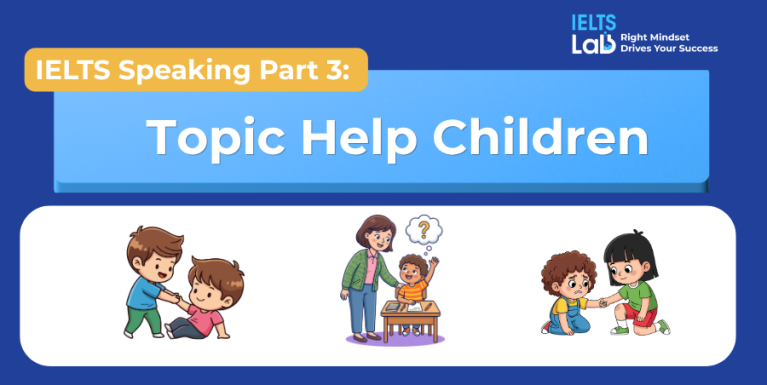
Helping Children (Giúp trẻ phát triển) là một chủ đề trong IELTS Speaking Part 3, với các câu hỏi xoay quanh trí thông minh, khả năng học hỏi của trẻ, vai trò của trường học và sự khác biệt về năng lực giữa mỗi người.
Cùng IELTS Lab tham khảo 6 bài mẫu Speaking Part 3 Band 8.0+ và những từ vựng hữu ích để phát triển câu trả lời tự nhiên, mạch lạc hơn nhé!
1. Danh sách câu hỏi IELTS Speaking Part 3 – Helping Children
Dưới đây là 6 câu hỏi thuộc chủ đề Helping Children để bạn luyện tập:
|
2. Bài mẫu IELTS Speaking Part 3 – Topic Helping Children
Question 1: Do you think children are born clever, or do they learn to be clever?
Sample Answer (Band 8.0+ tham khảo):
| Bài mẫu |
|---|
| Well, I think children are born with different natural abilities, but they also learn to be clever through experience and education. Some children may pick up languages, numbers, or music more quickly than others, which suggests that natural talent does exist. However, talent alone is not enough if children are not encouraged, taught, and given chances to practise. Another important factor is the environment around them. A child who reads books, asks questions, plays creative games, and receives support from adults may become much more capable over time. |
Từ vựng nổi bật:
| Từ vựng | Ý nghĩa |
|---|---|
| be born with natural abilities | Sinh ra đã có những khả năng bẩm sinh |
| pick up | Tiếp thu, học được một cách nhanh chóng |
| natural talent | Năng khiếu bẩm sinh |
| talent alone is not enough | Chỉ có tài năng thôi là chưa đủ |
| the environment around someone | Môi trường xung quanh một người |
| receive support from adults | Nhận được sự hỗ trợ từ người lớn |
| become more capable | Trở nên có năng lực hơn |
Question 2: How important are schools in helping children become more clever?
Sample Answer (Band 8.0+ tham khảo):
| Bài mẫu |
|---|
| Absolutely, schools are very important because they give children structured knowledge and regular practice. At school, children learn not only maths, science, and languages, but also how to think, ask questions, and solve problems. A good school can help students develop critical thinking instead of just memorizing facts. Another reason is that schools expose children to different subjects and activities, so they can discover what they are good at. For example, a child may not know they enjoy science until they do experiments in class. |
Từ vựng nổi bật:
| Từ vựng | Ý nghĩa |
|---|---|
| structured knowledge | Kiến thức được tổ chức có hệ thống |
| regular practice | Việc luyện tập thường xuyên |
| critical thinking | Tư duy phản biện |
| memorize facts | Ghi nhớ các thông tin, dữ kiện |
| expose someone to something | Giúp ai đó tiếp xúc, làm quen với điều gì |
| discover what one is good at | Khám phá điểm mạnh của bản thân |
| do experiments | Thực hiện các thí nghiệm |
Question 3: Do you agree or disagree that very clever children are usually happy?
Sample Answer (Band 8.0+ tham khảo):
| Bài mẫu |
|---|
| To be honest, I don’t fully agree because being clever does not always mean being happy. Clever children may do well in exams and receive praise, which can give them a sense of confidence. However, they may also face pressure from parents, teachers, or even themselves to keep performing well. Sometimes, very clever children feel lonely because their interests or thinking styles are different from their classmates. Another issue is that people may expect them to succeed all the time, which can be stressful. |
Từ vựng nổi bật:
| Từ vựng | Ý nghĩa |
|---|---|
| being clever does not always mean being happy | Thông minh không đồng nghĩa với hạnh phúc |
| do well in exams | Đạt kết quả tốt trong các kỳ thi |
| a sense of confidence | Cảm giác tự tin |
| face pressure | Đối mặt với áp lực |
| feel lonely | Cảm thấy cô đơn |
| thinking styles | Những cách tư duy |
| expect someone to succeed | Kỳ vọng ai đó thành công |
Question 4: Why may a person be very good at one thing, but not another?
Sample Answer (Band 8.0+ tham khảo):
| Bài mẫu |
|---|
| Well, people can be very good at one thing but not another because intelligence is not the same in every area. Someone may be excellent at maths but struggle with speaking in public, while another person may be great at music but weak at science. This happens because people have different natural strengths, interests, and learning styles. Another reason is practice. If someone spends years playing football or learning English, they will naturally become better at that area than at something they rarely practise. |
Từ vựng nổi bật:
| Từ vựng | Ý nghĩa |
|---|---|
| be excellent at something | Rất giỏi một lĩnh vực nào đó |
| struggle with something | Gặp khó khăn với điều gì |
| be weak at something | Yếu ở một kỹ năng hoặc môn học |
| natural strengths | Những điểm mạnh bẩm sinh |
| learning styles | Phong cách học tập |
| become better at something | Trở nên giỏi hơn ở một lĩnh vực |
| regular practice | Việc luyện tập thường xuyên |
Question 5: Why does society need people with different types of intelligence?
Sample Answer (Band 8.0+ tham khảo):
| Bài mẫu |
|---|
| Well, society needs different types of intelligence because no single skill can solve every problem. We need doctors and engineers who are strong in logic and science, but we also need artists, teachers, designers, carers, and businesspeople. Each group contributes something different to society and helps it function smoothly. For example, a city needs not only people who can build bridges, but also people who can educate children, care for patients, and create culture. Another reason is that modern problems are complex, so they require teamwork between people with different strengths. So, I think society becomes stronger when it values a wide range of talents. |
Từ vựng nổi bật:
| Từ vựng | Ý nghĩa |
|---|---|
| no single skill can solve every problem | Không một kỹ năng nào có thể giải quyết mọi vấn đề |
| be strong in logic and science | Có thế mạnh về logic và khoa học |
| contribute something to society | Đóng góp điều gì đó cho xã hội |
| function smoothly | Vận hành trơn tru |
| complex problems | Những vấn đề phức tạp |
| different strengths | Những thế mạnh khác nhau |
| a wide range of talents | Nhiều loại tài năng đa dạng |
Question 6: Do you think people can become very good at anything if they try hard enough?
Sample Answer (Band 8.0+ tham khảo):
| Bài mẫu |
|---|
| In my opinion, people can improve a lot if they try hard enough, but not everyone can become excellent at everything. Hard work, patience, and good training can help someone make steady progress in almost any skill. For example, a weak English learner can become much better if they practise speaking and listening every day. However, natural talent, physical ability, resources, and timing also matter. Someone may work extremely hard at singing or sports but still not reach a professional level. So, I’d say effort is powerful, but it does not completely remove personal limits. |
Từ vựng nổi bật:
| Từ vựng | Ý nghĩa |
|---|---|
| try hard enough | Cố gắng đủ nhiều |
| hard work and patience | Sự chăm chỉ và kiên nhẫn |
| good training | Sự đào tạo tốt |
| make steady progress | Tiến bộ đều đặn |
| natural talent | Năng khiếu bẩm sinh |
| physical ability | Năng lực thể chất |
| reach a professional level | Đạt đến trình độ chuyên nghiệp |
| personal limits | Những giới hạn cá nhân |
3. Mẹo trả lời IELTS Speaking Part 3 chủ đề Helping Children
Để trả lời tốt các câu hỏi IELTS Speaking Part 3 – Helping Children, bạn nên chú ý:
- Phát triển ý từ nhiều góc độ: Phân tích vai trò của năng khiếu bẩm sinh, môi trường giáo dục, sự luyện tập và động lực cá nhân đối với việc phát triển trí thông minh.
- Đưa ra ví dụ thực tế: Liên hệ đến việc học ngoại ngữ, toán học, âm nhạc, thể thao hoặc cách trường học giúp trẻ phát triển tư duy.
- Thể hiện quan điểm linh hoạt: Với các câu hỏi về trí thông minh và năng lực, hãy cân nhắc cả yếu tố bẩm sinh lẫn quá trình học hỏi thay vì đưa ra kết luận tuyệt đối.
- Sử dụng collocations tự nhiên: Những cụm từ như natural talent, critical thinking, face pressure, a wide range of talents, make steady progress giúp câu trả lời linh hoạt và chính xác hơn.
4. Luyện tập IELTS Speaking Part 3 cùng IELTS Lab
Chủ đề Helping Children không chỉ kiểm tra vốn từ về trí thông minh và giáo dục mà còn yêu cầu thí sinh giải thích sự khác biệt về năng lực, phân tích vai trò của nhà trường và đánh giá tầm quan trọng của nỗ lực đối với sự phát triển cá nhân.
Hy vọng 6 bài mẫu IELTS Speaking Part 3 – Helping Children trên sẽ giúp bạn mở rộng vốn từ, phát triển lập luận và tự tin hơn trong phòng thi.
Đừng quên theo dõi IELTS Lab để cập nhật thêm các bài mẫu IELTS Speaking theo chủ đề và phương pháp luyện thi hiệu quả nhé!








Để lại một bình luận
Bạn phải đăng nhập để gửi bình luận.