 0969-435-240
 info@ieltslab.edu.vn

 Liên hệ ngay
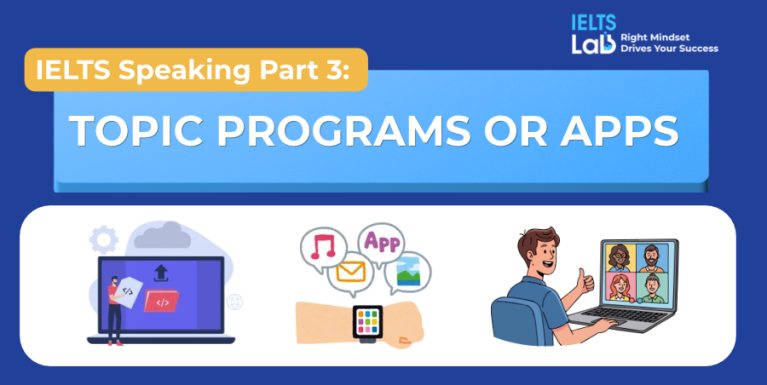
Programs or Apps (Ứng dụng và phần mềm) là một chủ đề quen thuộc trong IELTS Speaking Part 3, với các câu hỏi xoay quanh thói quen sử dụng ứng dụng, sự khác biệt giữa các thế hệ, thời gian sử dụng thiết bị và lợi ích của công nghệ trong giáo dục.
Cùng IELTS Lab tham khảo 5 bài mẫu Speaking Part 3 Band 8.0+ và những từ vựng hữu ích để phát triển câu trả lời tự nhiên, mạch lạc hơn nhé!
1. Danh sách câu hỏi IELTS Speaking Part 3 – Programs or Apps
Dưới đây là 5 câu hỏi thuộc chủ đề Programs or Apps để bạn luyện tập:
|
2. Bài mẫu IELTS Speaking Part 3 – Topic Programs or Apps
Question 1: What kinds of programs or apps are popular in your country?
Sample Answer (Band 8.0+ tham khảo):
| Well, in Vietnam, social media apps, messaging apps, shopping apps, banking apps, and entertainment apps are extremely popular.
Many people use Facebook, TikTok, Zalo, YouTube, and Shopee almost every day because these apps fit naturally into their daily routines. For young people, apps are often used for chatting, watching short videos, studying, and keeping up with trends. For adults, banking apps and delivery apps are useful because they save time and make daily tasks more convenient. |
Từ vựng nổi bật:
| Từ vựng | Ý nghĩa |
|---|---|
| social media apps | Ứng dụng mạng xã hội |
| messaging apps | Ứng dụng nhắn tin |
| fit naturally into one’s daily routine | Trở thành một phần tự nhiên trong sinh hoạt hằng ngày |
| keep up with trends | Bắt kịp xu hướng |
| make daily tasks more convenient | Giúp công việc hằng ngày thuận tiện hơn |
Question 2: Why do some people not like to use programs or apps?
Sample Answer (Band 8.0+ tham khảo):
| Well, some people do not like using apps because they find them confusing or stressful.
This is especially true for older people who are not used to digital technology and may worry about pressing the wrong button or losing money online. For them, a simple task like paying a bill through an app can feel much harder than doing it in person. Another reason is that some people are concerned about privacy and security. They may not want apps to collect personal information, track their location, or send too many notifications. All in all, people avoid apps either because they are not confident with technology or because they want to protect their privacy. |
Từ vựng nổi bật:
| Từ vựng | Ý nghĩa |
|---|---|
| be not used to digital technology | Chưa quen với công nghệ số |
| be concerned about privacy and security | Lo ngại về quyền riêng tư và bảo mật |
| protect one’s privacy | Bảo vệ quyền riêng tư |
| collect personal information | Thu thập thông tin cá nhân |
| track someone’s location | Theo dõi vị trí của ai đó |
| do something in person | Trực tiếp thực hiện việc gì |
Question 3: What are the differences between the kinds of apps and programs young people and old people use?
Sample Answer (Band 8.0+ tham khảo):
| Well, young people usually use apps for entertainment, communication, learning, and self-expression.
They may spend a lot of time on TikTok, Instagram, games, music platforms, or photo-editing apps because these apps help them stay connected with friends and trends. Many students also use learning apps, but they often prefer apps that are interactive and visually attractive. Older people, on the other hand, tend to use more practical apps, such as messaging, news, banking, weather, or health apps. They usually care less about trends and more about convenience, safety, and staying in touch with family. |
Từ vựng nổi bật:
| Từ vựng | Ý nghĩa |
|---|---|
| self-expression | Sự thể hiện bản thân |
| stay connected | Duy trì kết nối |
| interactive and visually attractive | Có tính tương tác và hấp dẫn về hình ảnh |
| practical apps | Những ứng dụng mang tính thực tiễn |
| photo-editing apps | Ứng dụng chỉnh sửa ảnh |
| stay in touch with family | Giữ liên lạc với gia đình |
Question 4: Is it necessary for parents to limit the time their children spend on apps or computer programs?
Sample Answer (Band 8.0+ tham khảo):
| Absolutely, I think parents should limit children’s screen time because apps and computer programs can be very addictive.
If children spend hours playing games or watching short videos, they may have less time for homework, sleep, exercise, and real conversations. This can affect their health and their ability to focus on important tasks. However, parents should not ban apps completely because many programs can support learning and creativity. For example, children can use apps to learn English, practise maths, draw pictures, or pick up basic coding skills. I think the key is not to remove technology, but to set healthy limits and teach children self-control. |
Từ vựng nổi bật:
| Từ vựng | Ý nghĩa |
|---|---|
| addictive | Có khả năng gây nghiện |
| screen time | Thời gian sử dụng màn hình |
| the ability to focus on important tasks | Khả năng tập trung vào những công việc quan trọng |
| support learning and creativity | Hỗ trợ việc học và khả năng sáng tạo |
| pick up a skill | Học, tiếp thu một kỹ năng |
| set healthy limits | Đặt ra những giới hạn lành mạnh |
| self-control | Khả năng tự kiểm soát |
Question 5: What are the benefits of using apps as a tool for education?
Sample Answer (Band 8.0+ tham khảo):
| Well, apps can be very useful in education because they make learning more flexible and interactive.
Students can study anytime, revise vocabulary on the bus, watch explanation videos at home, or practise listening on their phones. This is helpful because learning no longer has to happen only inside the classroom. Another benefit is that apps can make difficult subjects more engaging through quizzes, games, images, and instant feedback. For example, an English learning app can help students repeat pronunciation many times without feeling embarrassed. All in all, I think educational apps are valuable because they help students learn at their own pace and stay motivated. |
Từ vựng nổi bật:
| Từ vựng | Ý nghĩa |
|---|---|
| make learning more flexible and interactive | Giúp việc học linh hoạt và có tính tương tác hơn |
| study anytime | Học bất cứ lúc nào |
| revise vocabulary | Ôn tập từ vựng |
| instant feedback | Phản hồi tức thì |
| learn at one’s own pace | Học theo tốc độ phù hợp với bản thân |
| stay motivated | Duy trì động lực |
3. Mẹo trả lời IELTS Speaking Part 3 chủ đề Programs or Apps
Để trả lời tốt các câu hỏi IELTS Speaking Part 3 – Programs or Apps, bạn nên chú ý:
- Phát triển ý từ nhiều góc độ: Phân tích vai trò của ứng dụng trong giao tiếp, giải trí, công việc và giáo dục.
- Đưa ra ví dụ thực tế: Sử dụng những ứng dụng quen thuộc như TikTok, Zalo, YouTube hoặc các ứng dụng học ngoại ngữ để minh họa.
- So sánh giữa các thế hệ: Làm rõ sự khác biệt trong mục đích và thói quen sử dụng công nghệ của người trẻ và người lớn tuổi.
- Sử dụng collocations tự nhiên: Những cụm từ như keep up with trends, protect one’s privacy, set healthy limits, learn at one’s own pace giúp câu trả lời linh hoạt hơn.
4. Luyện tập IELTS Speaking Part 3 cùng IELTS Lab
Chủ đề Programs or Apps không chỉ yêu cầu vốn từ về công nghệ mà còn kiểm tra khả năng giải thích thói quen, so sánh các nhóm người và đánh giá lợi ích, hạn chế của ứng dụng trong cuộc sống.
Hy vọng 5 bài mẫu IELTS Speaking Part 3 – Programs or Apps trên sẽ giúp bạn bổ sung từ vựng, phát triển lập luận và tự tin hơn trong phòng thi.
Đừng quên theo dõi IELTS Lab để cập nhật thêm các bài mẫu IELTS Speaking theo chủ đề và phương pháp luyện thi hiệu quả nhé!











Để lại một bình luận
Bạn phải đăng nhập để gửi bình luận.