 0969-435-240
 info@ieltslab.edu.vn

 Liên hệ ngay
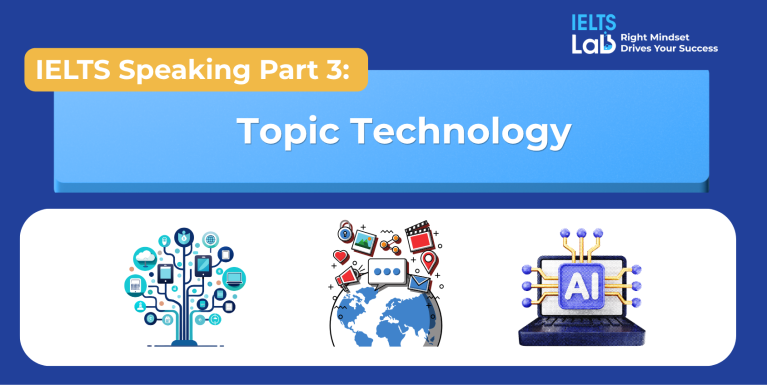
Technology (Công nghệ) là một chủ đề trong IELTS Speaking Part 3, với các câu hỏi xoay quanh những vấn đề kỹ thuật thường gặp, sự khác biệt giữa các thế hệ khi sử dụng thiết bị số, lợi ích của công nghệ và mức độ phụ thuộc vào công nghệ trong cuộc sống hiện đại.
Cùng IELTS Lab tham khảo 6 bài mẫu Speaking Part 3 Band 8.0+ và những từ vựng hữu ích để phát triển câu trả lời tự nhiên, mạch lạc hơn nhé!
1. Danh sách câu hỏi IELTS Speaking Part 3 – Technology
Dưới đây là 6 câu hỏi thuộc chủ đề Technology để bạn luyện tập:
|
2. Bài mẫu IELTS Speaking Part 3 – Topic Technology
Question 1: What kinds of technological problems do people often face?
Sample Answer (Band 8.0+ tham khảo):
| Bài mẫu |
|---|
| Well, people often face problems like slow internet, weak phone batteries, software errors, frozen screens, lost passwords, and online scams. These issues can be frustrating because technology is now part of work, study, banking, and communication. For example, if the internet suddenly stops during an online class or meeting, everything can be interrupted. Another common problem is data security. People may receive fake links, suspicious messages, or phishing emails that try to steal personal information. |
Từ vựng nổi bật:
| Từ vựng | Ý nghĩa |
|---|---|
| slow internet | Mạng Internet chậm |
| weak phone batteries | Pin điện thoại yếu |
| software errors | Lỗi phần mềm |
| frozen screens | Màn hình bị đơ |
| online scams | Các hình thức lừa đảo trực tuyến |
| frustrating | Gây khó chịu, bực bội |
| be interrupted | Bị gián đoạn |
| data security | Bảo mật dữ liệu |
| phishing emails | Email lừa đảo nhằm đánh cắp thông tin |
| personal information | Thông tin cá nhân |
Question 2: Do older people have more difficulty using technology than young people?
Sample Answer (Band 8.0+ tham khảo):
| Bài mẫu |
|---|
| Yes, older people often have more difficulty because they did not grow up with digital devices. Many young people learn to use smartphones and apps naturally from an early age, while older people may need more time and explanation. For example, online banking, QR codes, or account verification can feel confusing or risky for them. Another reason is fear. Some older people are afraid of pressing the wrong button or losing money online. So, I think older people can learn technology, but they usually need more patience, practice, and step-by-step guidance. |
Từ vựng nổi bật:
| Từ vựng | Ý nghĩa |
|---|---|
| grow up with digital devices | Lớn lên cùng các thiết bị kỹ thuật số |
| from an early age | Từ khi còn nhỏ |
| online banking | Ngân hàng trực tuyến |
| account verification | Xác minh tài khoản |
| confusing or risky | Khó hiểu hoặc tiềm ẩn rủi ro |
| press the wrong button | Bấm nhầm nút |
| lose money online | Mất tiền trên mạng |
| patience and practice | Sự kiên nhẫn và luyện tập |
| step-by-step guidance | Hướng dẫn từng bước |
Question 3: How has technology made people’s lives easier?
Sample Answer (Band 8.0+ tham khảo):
| Bài mẫu |
|---|
| Well, technology has made life easier by saving time and making services more convenient. People can transfer money, order food, book transport, study online, and communicate instantly without leaving home. For example, instead of going to a bank, people can pay bills with a few taps on a phone. Another benefit is access to information. People can learn languages, search for health advice, compare prices, or solve work problems much faster than before. All in all, I think technology makes life easier because it helps people get things done quickly and efficiently. |
Từ vựng nổi bật:
| Từ vựng | Ý nghĩa |
|---|---|
| save time | Tiết kiệm thời gian |
| make services more convenient | Khiến các dịch vụ thuận tiện hơn |
| transfer money | Chuyển tiền |
| book transport | Đặt phương tiện di chuyển |
| communicate instantly | Giao tiếp ngay lập tức |
| pay bills | Thanh toán hóa đơn |
| a few taps on a phone | Một vài thao tác chạm trên điện thoại |
| access to information | Khả năng tiếp cận thông tin |
| compare prices | So sánh giá cả |
| get things done | Hoàn thành công việc |
Question 4: Do you think people depend too much on technology nowadays?
Sample Answer (Band 8.0+ tham khảo):
| Bài mẫu |
|---|
| To be honest, yes, I think many people depend too much on technology nowadays. If their phone runs out of battery or the internet stops working, they may feel lost or unable to do basic tasks. People use technology for directions, memory, entertainment, communication, and even simple calculations. However, this dependence is understandable because technology is genuinely useful and deeply connected to modern life. The problem starts, however, when people cannot focus, communicate, or solve problems without digital support. |
Từ vựng nổi bật:
| Từ vựng | Ý nghĩa |
|---|---|
| depend too much on technology | Phụ thuộc quá nhiều vào công nghệ |
| run out of battery | Hết pin |
| feel lost | Cảm thấy lúng túng, không biết phải làm gì |
| basic tasks | Những công việc cơ bản |
| this dependence is understandable | Sự phụ thuộc này có thể hiểu được |
| genuinely useful | Thực sự hữu ích |
| modern life | Cuộc sống hiện đại |
| digital support | Sự hỗ trợ từ công nghệ số |
| solve problems | Giải quyết vấn đề |
Question 5: What should people do when technology fails?
Sample Answer (Band 8.0+ tham khảo):
| Bài mẫu |
|---|
| Well, when technology fails, people should stay calm and try to identify the problem first. They can restart the device, check the connection, update the software, or ask someone with more experience for help. If the problem is serious, such as a banking error or data loss, they should contact support instead of trusting random online advice. Another useful habit is having backup plans. For example, people should save important files in more than one place and keep emergency phone numbers written down. So, I think the best response is to stay practical, avoid panic, and prepare for technical problems in advance. |
Từ vựng nổi bật:
| Từ vựng | Ý nghĩa |
|---|---|
| technology fails | Công nghệ gặp sự cố |
| stay calm | Giữ bình tĩnh |
| identify the problem | Xác định vấn đề |
| restart the device | Khởi động lại thiết bị |
| check the connection | Kiểm tra kết nối |
| update the software | Cập nhật phần mềm |
| data loss | Mất dữ liệu |
| contact support | Liên hệ bộ phận hỗ trợ |
| have backup plans | Có phương án dự phòng |
| avoid panic | Tránh hoảng loạn |
| prepare in advance | Chuẩn bị trước |
Question 6: Will technology become more reliable in the future?
Sample Answer (Band 8.0+ tham khảo):
| Bài mẫu |
|---|
| Well, I think technology will become more reliable in many ways because companies are constantly improving systems, security, and user experience. Devices may become faster, batteries may last longer, and AI may help detect problems before they become serious. However, technology will probably never be perfect because systems are becoming more complex. New tools can also create new problems, such as privacy risks or cyberattacks. Because of this, I’d say technology will improve, but people will still need to use it carefully. |
Từ vựng nổi bật:
| Từ vựng | Ý nghĩa |
|---|---|
| more reliable | Đáng tin cậy hơn |
| improve systems | Cải thiện hệ thống |
| user experience | Trải nghiệm người dùng |
| batteries last longer | Pin có thời lượng sử dụng lâu hơn |
| detect problems | Phát hiện vấn đề |
| never be perfect | Không bao giờ hoàn hảo |
| complex | Phức tạp |
| privacy risks | Những rủi ro về quyền riêng tư |
| cyberattacks | Các cuộc tấn công mạng |
| use technology carefully | Sử dụng công nghệ cẩn thận |
3. Mẹo trả lời IELTS Speaking Part 3 chủ đề Technology
Để trả lời tốt các câu hỏi IELTS Speaking Part 3 – Technology, bạn nên chú ý:
- Phát triển ý từ nhiều góc độ: Phân tích công nghệ dựa trên sự tiện lợi, năng suất làm việc, bảo mật thông tin, khả năng tiếp cận và sự phụ thuộc của con người.
- Đưa ra ví dụ thực tế: Liên hệ đến điện thoại thông minh, ngân hàng trực tuyến, ứng dụng học tập, trí tuệ nhân tạo hoặc các sự cố mất kết nối Internet.
- Thể hiện quan điểm cân bằng: Với câu hỏi về sự phụ thuộc vào công nghệ hay tương lai của các thiết bị số, hãy đề cập cả những lợi ích và rủi ro tiềm ẩn.
- Sử dụng collocations tự nhiên: Những cụm từ như data security, step-by-step guidance, access to information, run out of battery, have backup plans giúp câu trả lời tự nhiên và chính xác hơn.
4. Luyện tập IELTS Speaking Part 3 cùng IELTS Lab
Chủ đề Technology không chỉ kiểm tra vốn từ về thiết bị điện tử và công nghệ số mà còn yêu cầu thí sinh phân tích sự thay đổi trong cuộc sống hiện đại, đánh giá lợi ích và hạn chế của công nghệ, cũng như đề xuất các giải pháp khi gặp sự cố kỹ thuật.
Hy vọng 6 bài mẫu IELTS Speaking Part 3 – Technology trên sẽ giúp bạn mở rộng vốn từ, phát triển lập luận và tự tin hơn trong phòng thi.
Đừng quên theo dõi IELTS Lab để cập nhật thêm các bài mẫu IELTS Speaking theo chủ đề và phương pháp luyện thi hiệu quả nhé!










Để lại một bình luận
Bạn phải đăng nhập để gửi bình luận.